During job shadow day, several teenagers and I designed a game, built a game, and shipped a game. You can play it here: Breaking Bones
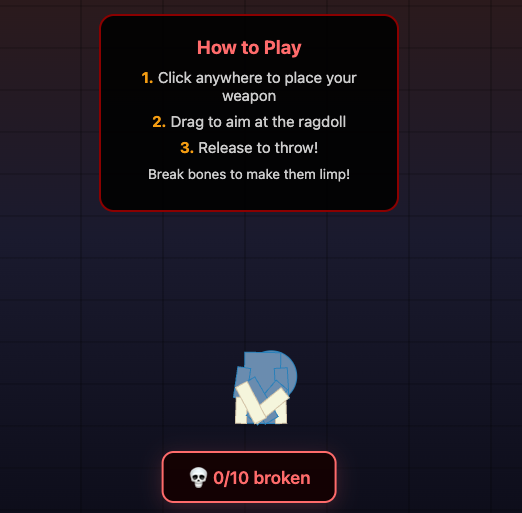
Here is how we went about it.
Earlier this month it was job shadow day for my teenage kid at school. I invited his classmates to join and together we used design thinking and claude code to design, build, and ship a game.
When you give people full freedom to explore their creative side, you have to be prepared for the unexpected. The kids unleashed their inner shadow and designed a game called Breaking Bones where you break bones for points. There’s something poetic about kids exploring their shadow side on job shadow day. It’s not what I would personally choose but hey, it was their game. Once they set out on this path, all you can do is play it out.
Preparation
To prepare for this event, I first brainstormed with AI on how to best fill the time we had. As it often happens, the brainstorming part is pretty messy and you end up with lots of ideas that you then need to simplify. I saved off all of our messy brainstorming in a Google drive document.
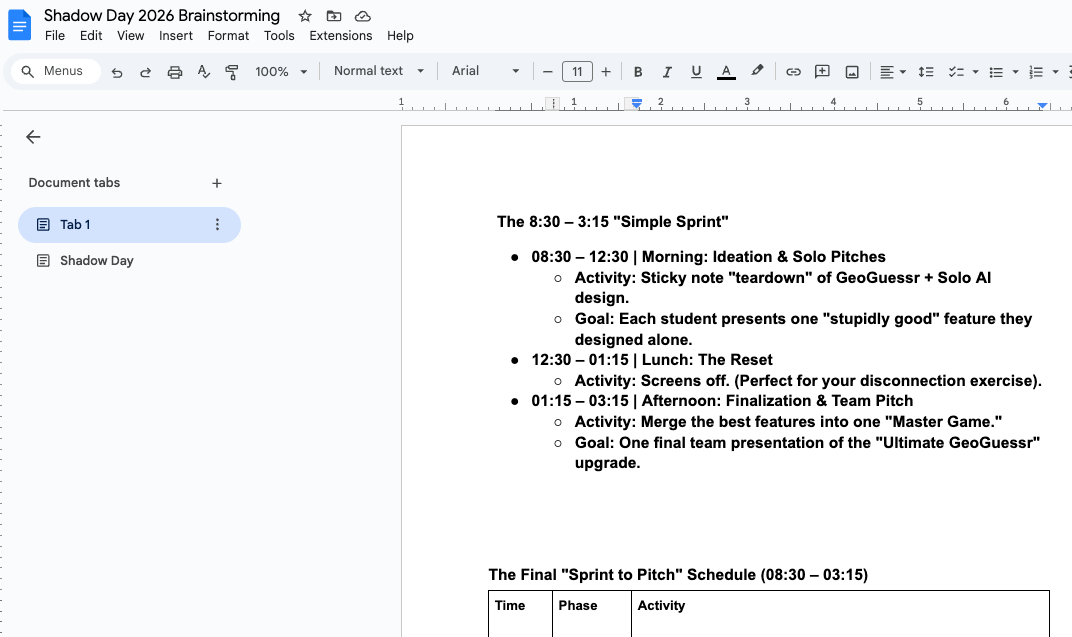
As the event got closer, I needed to turn that mess into something usable. I simplified it down to a 3-hour schedule focused on one thing: design, build, and ship a game.
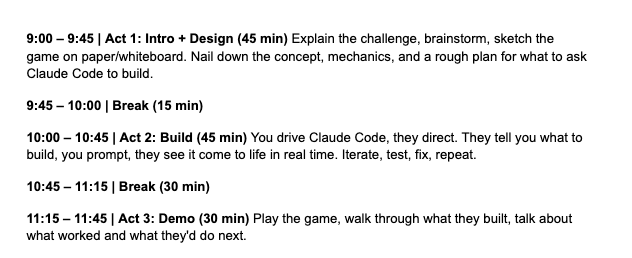
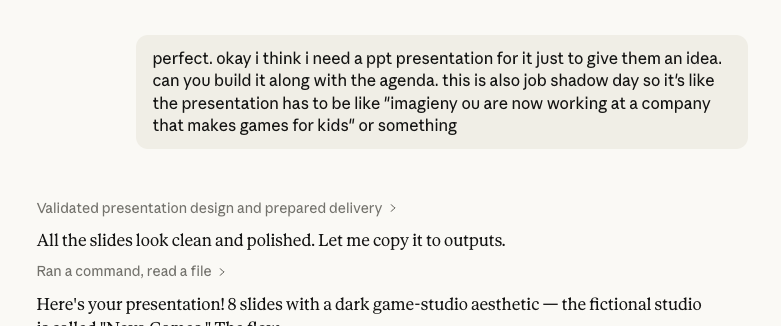
I wanted the kids to have a visual guide to follow during the day, but I didn’t have time to build a presentation from scratch. So I handed claude my simplified schedule and asked it to turn it into a presentation…and look at what came back.
Here is the prompt I used, typos and all. I used to be the type of person who needed everything spelled out perfectly. I decided I didn’t need to be that person anymore. AI understood what I meant despite the typos.
Here is the intro slide of the presentation. Isn’t it cool? Much better than I would be able to manually create in the time it took claude to come up with it.
Game Time
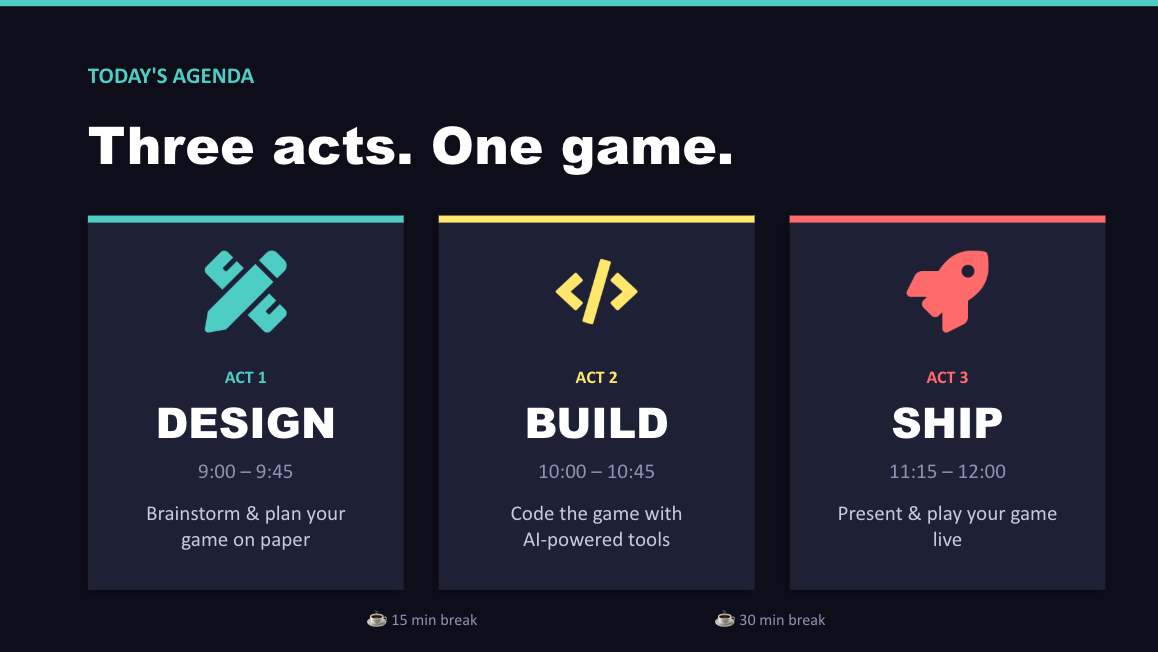
When the day came, we used three simple acts to design, build, and ship a game:
- Design act
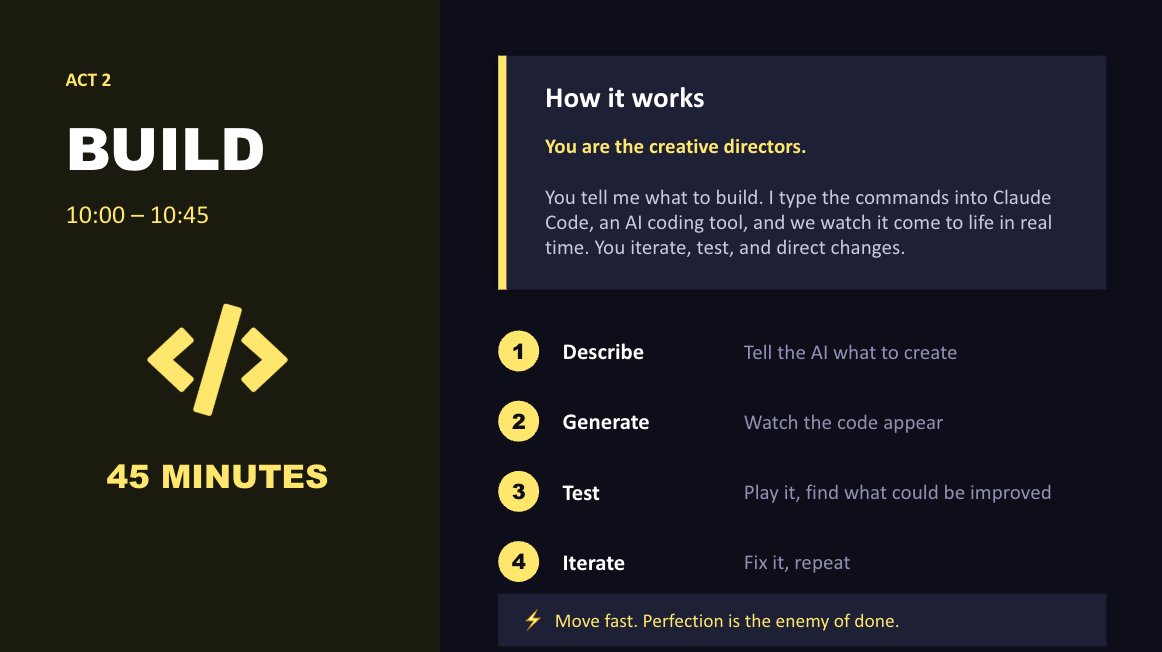
- Build act
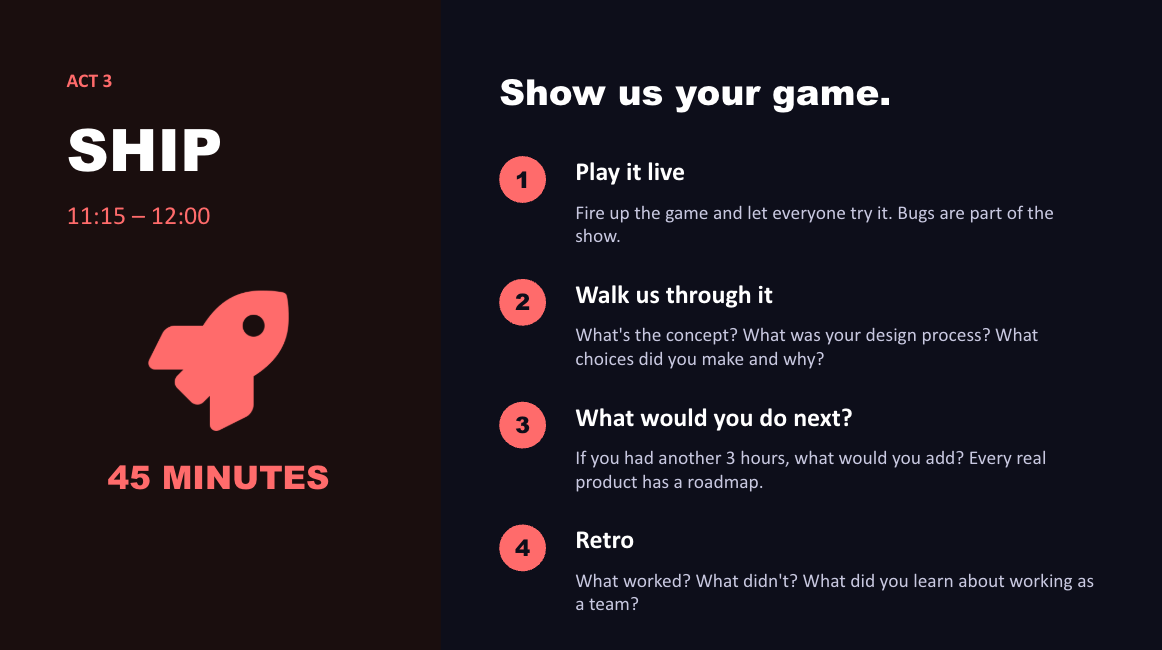
- Ship act
Act 1 - Design
The design act used design thinking methodologies to make sure everyone’s voices were heard and we removed biases.
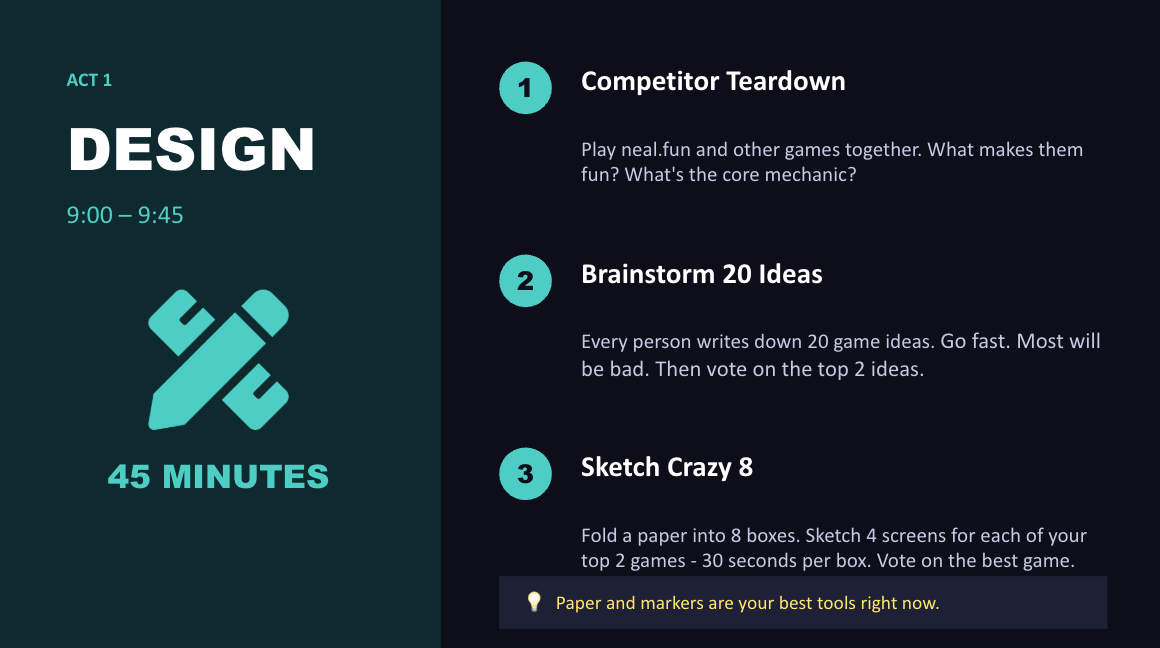
Competitor Teardown
First we looked at similar games together. We did have to improvise as our access to neal.fun was blocked. Thankfully I already had some games built so I ran the games locally on my computer and we played them and talked about what we’d improve.
Brainstorm 20 Ideas
Then each child wrote down their ideas for the new games on paper by hand. I gave them 5 minutes to come up with 20 ideas. Asking them to come up with 20 ideas is very intentional as it forces their brain to get creative. I could tell some children had a more difficult time with this exercise and I encouraged them to simply write a single word for each game. We can always elaborate later. I gave them examples, such as “rain” or “chair” as those could be made into all sorts of games.
For rain, it could be: rain simulation, catch rain in buckets, estimate how much rain falls in a given country, compare rainfall between two areas, etc.
For chair, it could be: design a chair, break a chair, throw a chair, stack chairs, etc.
Once they were done, I collected the papers and read every idea to the group. This way, no one knew who wrote what and they could vote without bias. To be fair, since we had a mix of boys and girls, the destruction-themed ideas weren’t fully anonymous.
Through a discussion we selected 2 ideas to advance to the next round. In our case, the ideas were: potato and breaking bones.
Sketch Crazy 8
For the Crazy 8 exercise, you fold a paper into 8 rectangles and spend 2 minutes sketching ideas in each one.
This is another example of a design thinking exercise, which forces your brain to get creative and under time pressure create something.
I took a shot at it as well and here is what I created:
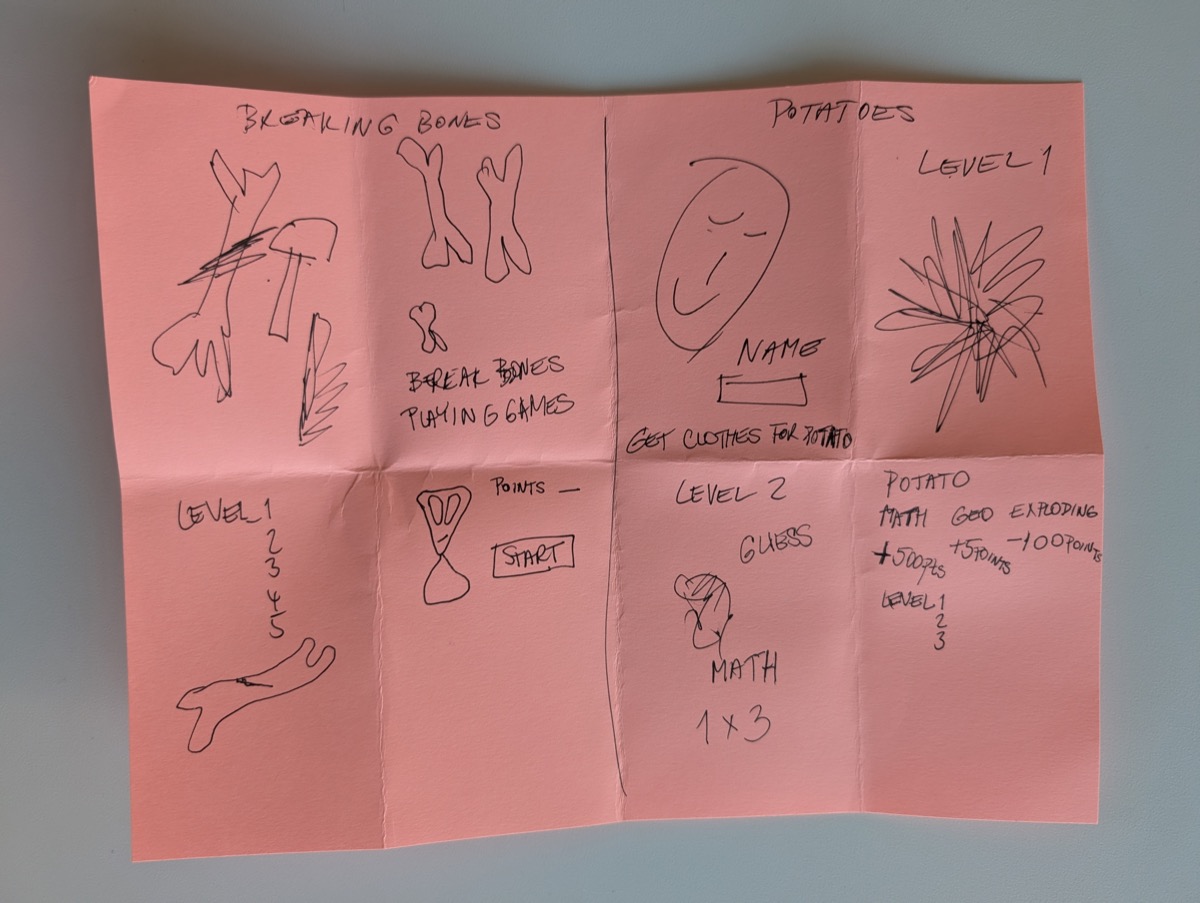
As you can see, these are very rough sketches and ideas. They can be super random and you can pivot if you do not like the direction your sketches are going.
Kids loved this portion of the exercise and ended up spending more time on it than originally allotted. That’s okay. The point was to have fun and if they love drawing, let them draw.
Finally, to wrap up the design act, each child presented their crazy 8 designs and talked through how they imagined the games. At this point, we still had 2 contenders for the main game: potato and breaking bones.
Act 2 - Let’s Build It
After a brief break, now came time to build.
We still had to finalize which game to build. Much to my personal discomfort, the kids selected breaking bones as the winner. Here I am thinking…how in the world are we going to build a breaking bones game? Is it too violent?
But the kids had spoken, so I rolled with it.
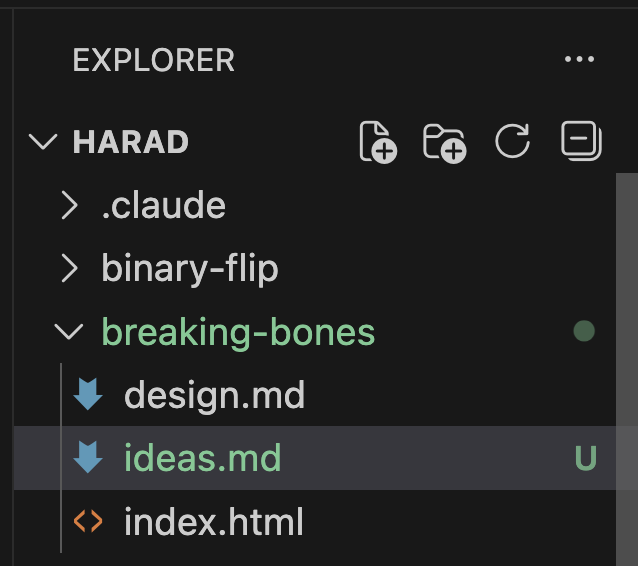
Since I had limited time and kids with varied opinions, I created an ideas.md file in my directory in visual studio.
Prototype
I had each kid come up and talk about how they imagined the game would work, which was captured in the ideas file.
I then asked claude to read the ideas.md file and claude was able to recognize the divergence of ideas and walked us through a series of questions which narrowed down our focus.
Pro tip: If using claude code via terminal, make sure you enter /plan mode when creating larger pieces of work.
Then the kids went at it! I also gave claude images of the crazy 8 designs we put together to have ideas and before we knew it, the initial prototype was made.
Iterations
We went through several iterations of improving the game. The kids were adding new weapons, describing how each one should look and behave, designing an advanced mode for when you’ve unlocked everything. They had opinions about everything.
Before I knew it, I was kicked out from the team and the kids completely took over in creating the game. They did not need me anymore to facilitate and my adult ideas were not welcome anymore. Such is life.
They went through about 15 iterations before they were happy with what they built.
Act 3 - Ship it
In the end, we decided to ship our game.

The kids presented their game to their parents, what they learned, what they improved, what they liked, what they disliked, what they would do if given more time.
I deployed the game using Cloudflare and you can play it here: Breaking Bones
In three hours, a group of teenagers went from a blank piece of paper to a live game on the internet. Not bad for a job shadow day.
A quick note: I used the paid version of Claude Code via terminal on my MacBook. You can follow a similar process with the free version of Claude, ChatGPT, or other tools. Reach out if you need help adapting the steps.